
That question took center stage at the first Daikin U.S. Open House of 2026, a joint session with Daikin Applied at the Daikin Sustainability and Innovation Center in Washington, D.C. that gathered industry leaders to discuss the energy and policy considerations surrounding the rapid growth of data center infrastructure.
The conversation featured:
- Todd House, Senior Director of Global External Affairs at CyrusOne, which designs, builds, and operates industry-leading data centers globally for the world's leading enterprises
- Matt Malinowski, Director of the Buildings Program at the American Council for an Energy Efficient Economy (ACEEE)
- Thomas Driscoll, Director of Data Center Engineering at Daikin Applied
That makes energy-efficient cooling solutions one of the most powerful tools available for reducing the overall energy footprint of our digital infrastructure, and just as important as identifying the right land and power source.[1]The panelists made one thing clear: cooling is no longer a secondary concern - it's mission-critical. Consider this: cooling accounts for up to 40% of a data center's total energy consumption
The challenge is compounding. Panelists noted that AI power demand is surging every day, and new fossil fuel generation cannot be built fast enough for the data centers we're planning to build. That makes new renewable energy sources, freeing up capacity on the grid through efficiency and flexibility of existing buildings and industry, along with dramatically more efficient cooling, not just preferable, but essential. Panelists noted that Hyperscalers have paved a path through their past investments in solar power.

Attendees explore sustainability and climate-focused exhibits at Daikin’s Sustainability and Innovation Center during the DSIC Open House.
"At the scale data centers are growing, efficiency is essential," noted Daikin Applied’s Driscoll. "Daikin's cooling solutions deliver the reliability data centers need, while meeting the efficiency demands of a rapidly evolving grid."
On the technology front, the discussion highlighted promising developments, including closed-loop water systems that use significantly less water than direct liquid cooling. Analysts estimate the data center HVAC hardware market will grow from $6.7 billion in 2023 to $16.6 billion by 2030, and backed by bold product innovation, strategic acquisitions, and a new dedicated global data center business unit, Daikin is helping power this future. Daikin Applied recently announced a $163 million investment in an expanded R&D test lab at our Plymouth, Minn., headquarters. Strategic acquisitions, including DDC Solutions for modular white space cooling and Chilldyne for liquid cooling, strengthen our end-to-end portfolio.
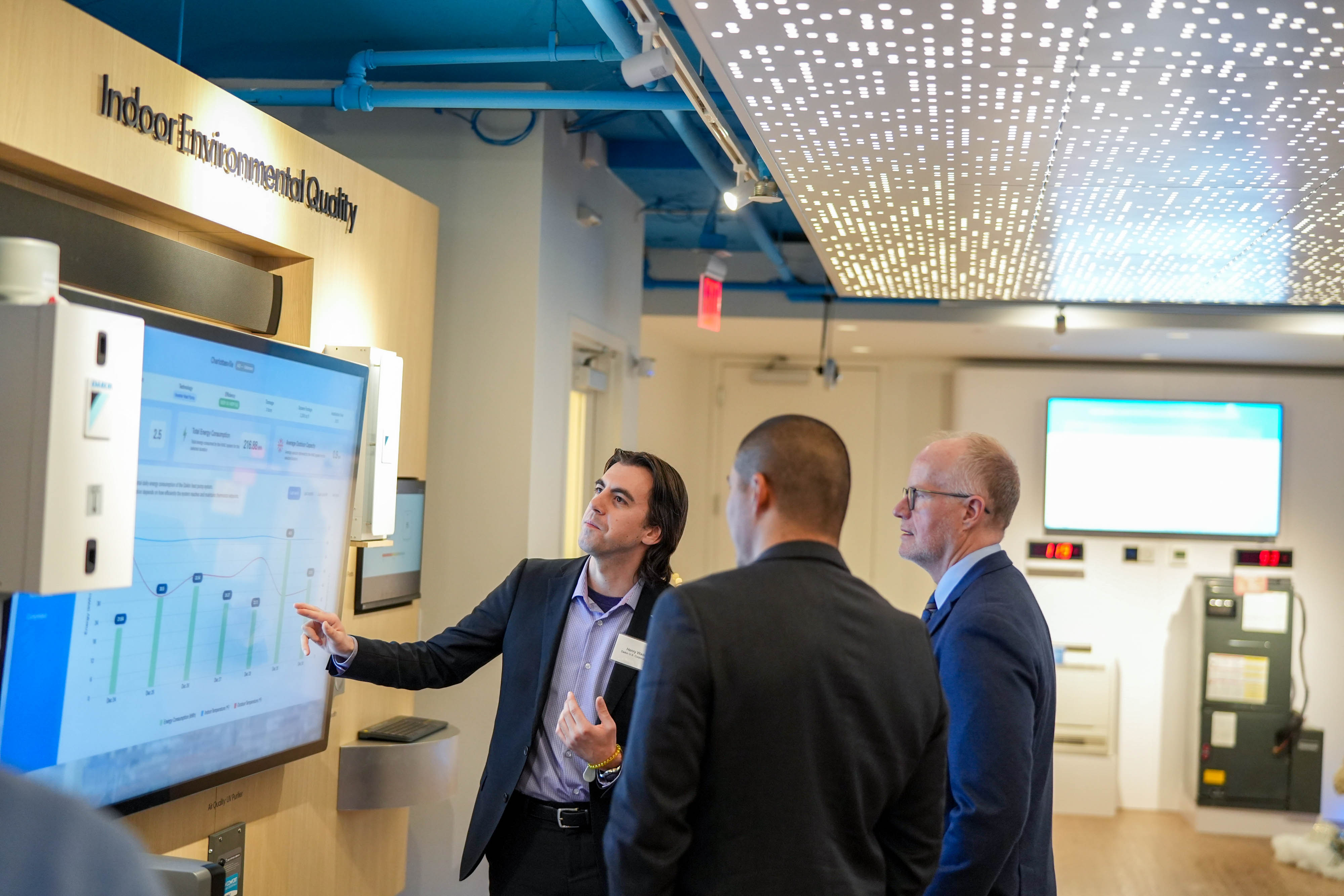
Attendees explore sustainability and climate-focused exhibits at Daikin’s Sustainability and Innovation Center during the DSIC Open House.
When it comes to policy, Malinowski highlighted a recent ACEEE white paper, which argued that, “Utilities and states could implement programs and policies to help spur efficiency and demand flexibility progress. Potential opportunities include efficiency and flexibility targets (mandatory, voluntary, or tied to electric rates) as well as energy savings incentive programs.”
CyrusOne’s Todd House reiterated the importance of flexibility in any policymaking, given how quickly the industry and technologies continue to evolve.
As data centers become the backbone of our digital society, energy-efficient cooling will play a central role in making AI-powered growth sustainable for the long term. Daikin looks forward to convening many more insightful dialogues on this and other critical topics throughout 2026.
[1] https://www.energy.gov/articles/doe-announces-40-million-more-efficient-cooling-data-centers